IupAlarm
Shows a modal dialog containing a message and up to three buttons.
Creation and Show
int IupAlarm(const char *t, const char *m, const char *b1, const char *b2, const char *b3);t: Dialog’s title
m: Message
b1: Text of the first button
b2: Text of the second button (optional)
b3: Text of the third button (optional)
Returns: the number of the button selected by the user (1, 2 or 3) , or 0 if failed. It fails only if b1 is not defined.
Notes
This function shows a dialog centralized on the screen, with the message and the buttons. The ‘\n’ character can be added to the message to indicate line change.
A button is not shown if its parameter is NULL. This is valid only for b2 and b3.
Button 1 is set as the "DEFAULTENTER" and "DEFAULTESC". If Button 2 exists, it is set as the "DEFAULTESC". If Button 3 exists, it is set as the "DEFAULTESC".
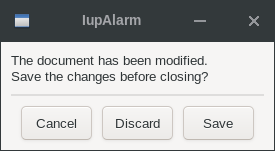
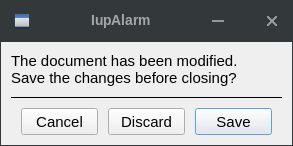
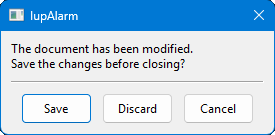
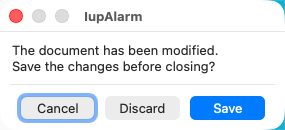
Callers must pass the primary action as b1 and the cancel/destructive action as the last present button. IUP reorders the buttons visually per host platform's HIG; the return value and the DEFAULTENTER/DEFAULTESC bindings stay the same.
The dialog uses a global attribute called "PARENTDIALOG" as the parent dialog if it is defined. It also uses a global attribute called "ICON" as the dialog icon if it is defined.
Examples
| GTK | Qt | Win32 | macOS |
 |
 |
 |
 |